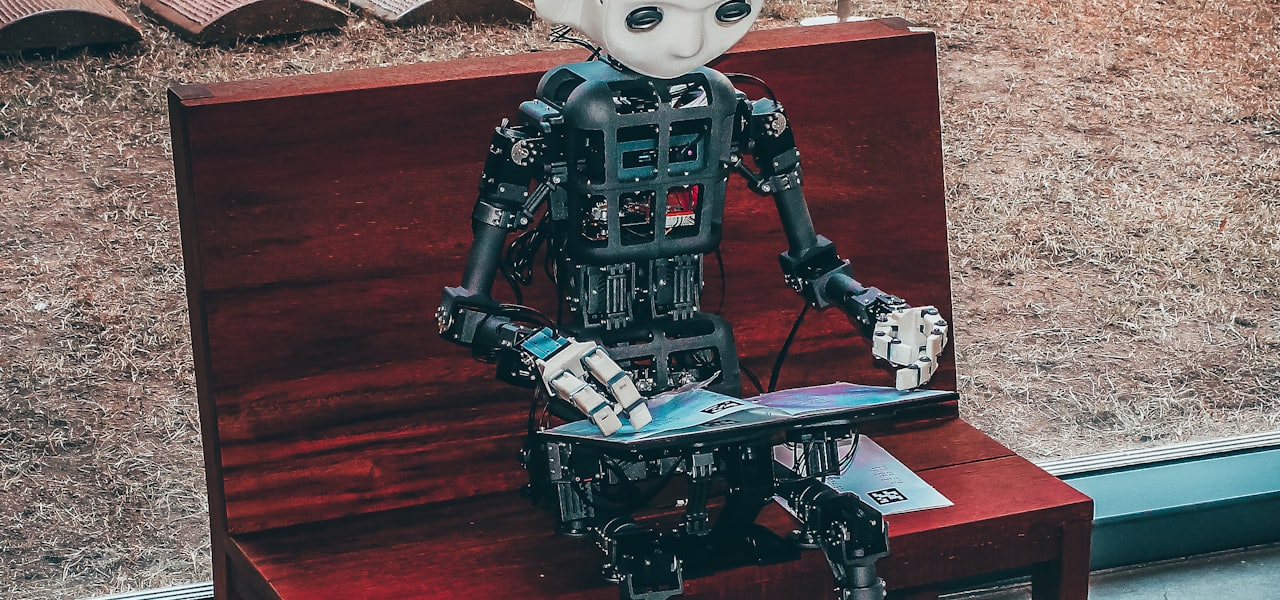
Human image synthesis is technology that can be applied to make believable and even photorealistic renditions of human-likenesses, moving or still. It has effectively existed since the early 2000s. Many films using computer generated imagery have featured synthetic images of human-like characters digitally composited onto the real or other simulated film material. Towards the end of the 2010s deep learning artificial intelligence has been applied to synthesize images and video that look like humans, without need for human assistance, once the training phase has been completed, whereas the old school 7D-route required massive amounts of human work. == Timeline of human image synthesis == In 1971 Henri Gouraud made the first CG geometry capture and representation of a human face. Modeling was his wife Sylvie Gouraud. The 3D model was a simple wire-frame model and he applied the Gouraud shader he is most known for to produce the first known representation of human-likeness on computer. The 1972 short film A Computer Animated Hand by Edwin Catmull and Fred Parke was the first time that computer-generated imagery was used in film to simulate moving human appearance. The film featured a computer simulated hand and face (watch film here). The 1976 film Futureworld reused parts of A Computer Animated Hand on the big screen. The 1983 music video for song Musique Non-Stop by German band Kraftwerk aired in 1986. Created by the artist Rebecca Allen, it features non-realistic looking, but clearly recognizable computer simulations of the band members. The 1994 film The Crow was the first film production to make use of digital compositing of a computer simulated representation of a face onto scenes filmed using a body double. Necessity was the muse as the actor Brandon Lee portraying the protagonist was tragically killed accidentally on-stage. In 1999 Paul Debevec et al. of USC captured the reflectance field of a human face with their first version of a light stage. They presented their method at the SIGGRAPH 2000 In 2003 audience debut of photo realistic human-likenesses in the 2003 films The Matrix Reloaded in the burly brawl sequence where up-to-100 Agent Smiths fight Neo and in The Matrix Revolutions where at the start of the end showdown Agent Smith's cheekbone gets punched in by Neo leaving the digital look-alike unnaturally unhurt. The Matrix Revolutions bonus DVD documents and depicts the process in some detail and the techniques used, including facial motion capture and limbal motion capture, and projection onto models. In 2003 The Animatrix: Final Flight of the Osiris a state-of-the-art want-to-be human likenesses not quite fooling the watcher made by Square Pictures. In 2003 digital likeness of Tobey Maguire was made for movies Spider-man 2 and Spider-man 3 by Sony Pictures Imageworks. In 2005 the Face of the Future project was an established. by the University of St Andrews and Perception Lab, funded by the EPSRC. The website contains a "Face Transformer", which enables users to transform their face into any ethnicity and age as well as the ability to transform their face into a painting (in the style of either Sandro Botticelli or Amedeo Modigliani). This process is achieved by combining the user's photograph with an average face. In 2009 Debevec et al. presented new digital likenesses, made by Image Metrics, this time of actress Emily O'Brien whose reflectance was captured with the USC light stage 5 Motion looks fairly convincing contrasted to the clunky run in the Animatrix: Final Flight of the Osiris which was state-of-the-art in 2003 if photorealism was the intention of the animators. In 2009 a digital look-alike of a younger Arnold Schwarzenegger was made for the movie Terminator Salvation though the end result was critiqued as unconvincing. Facial geometry was acquired from a 1984 mold of Schwarzenegger. In 2010 Walt Disney Pictures released a sci-fi sequel entitled Tron: Legacy with a digitally rejuvenated digital look-alike of actor Jeff Bridges playing the antagonist CLU. In SIGGGRAPH 2013 Activision and USC presented a real-time "Digital Ira" a digital face look-alike of Ari Shapiro, an ICT USC research scientist, utilizing the USC light stage X by Ghosh et al. for both reflectance field and motion capture. The end result both precomputed and real-time rendering with the modernest game GPU shown here and looks fairly realistic. In 2014 The Presidential Portrait by USC Institute for Creative Technologies in conjunction with the Smithsonian Institution was made using the latest USC mobile light stage wherein President Barack Obama had his geometry, textures and reflectance captured. In 2014 Ian Goodfellow et al. presented the principles of a generative adversarial network. GANs made the headlines in early 2018 with the deepfakes controversies. For the 2015 film Furious 7 a digital look-alike of actor Paul Walker who died in an accident during the filming was done by Weta Digital to enable the completion of the film. In 2016 techniques which allow near real-time counterfeiting of facial expressions in existing 2D video have been believably demonstrated. In 2016 a digital look-alike of Peter Cushing was made for the Rogue One film where its appearance would appear to be of same age as the actor was during the filming of the original 1977 Star Wars film. In SIGGRAPH 2017 an audio driven digital look-alike of upper torso of Barack Obama was presented by researchers from University of Washington. It was driven only by a voice track as source data for the animation after the training phase to acquire lip sync and wider facial information from training material consisting 2D videos with audio had been completed. Late 2017 and early 2018 saw the surfacing of the deepfakes controversy where porn videos were doctored using deep machine learning so that the face of the actress was replaced by the software's opinion of what another persons face would look like in the same pose and lighting. In 2018 Game Developers Conference Epic Games and Tencent Games demonstrated "Siren", a digital look-alike of the actress Bingjie Jiang. It was made possible with the following technologies: CubicMotion's computer vision system, 3Lateral's facial rigging system and Vicon's motion capture system. The demonstration ran in near real time at 60 frames per second in the Unreal Engine 4. In 2018 at the World Internet Conference in Wuzhen the Xinhua News Agency presented two digital look-alikes made to the resemblance of its real news anchors Qiu Hao (Chinese language) and Zhang Zhao (English language). The digital look-alikes were made in conjunction with Sogou. Neither the speech synthesis used nor the gesturing of the digital look-alike anchors were good enough to deceive the watcher to mistake them for real humans imaged with a TV camera. In September 2018 Google added "involuntary synthetic pornographic imagery" to its ban list, allowing anyone to request the search engine block results that falsely depict them as "nude or in a sexually explicit situation." In February 2019 Nvidia open sources StyleGAN, a novel generative adversarial network. Right after this Phillip Wang made the website ThisPersonDoesNotExist.com with StyleGAN to demonstrate that unlimited amounts of often photo-realistic looking facial portraits of no-one can be made automatically using a GAN. Nvidia's StyleGAN was presented in a not yet peer reviewed paper in late 2018. At the June 2019 CVPR the MIT CSAIL presented a system titled "Speech2Face: Learning the Face Behind a Voice" that synthesizes likely faces based on just a recording of a voice. It was trained with massive amounts of video of people speaking. Since 1 July 2019 Virginia has criminalized the sale and dissemination of unauthorized synthetic pornography, but not the manufacture., as § 18.2–386.2 titled 'Unlawful dissemination or sale of images of another; penalty.' became part of the Code of Virginia. The law text states: "Any person who, with the intent to coerce, harass, or intimidate, maliciously disseminates or sells any videographic or still image created by any means whatsoever that depicts another person who is totally nude, or in a state of undress so as to expose the genitals, pubic area, buttocks, or female breast, where such person knows or has reason to know that he is not licensed or authorized to disseminate or sell such videographic or still image is guilty of a Class 1 misdemeanor.". The identical bills were House Bill 2678 presented by Delegate Marcus Simon to the Virginia House of Delegates on 14 January 2019 and three-day later an identical Senate bill 1736 was introduced to the Senate of Virginia by Senator Adam Ebbin. Since 1 September 2019 Texas senate bill SB 751 amendments to the election code came into effect, giving candidates in elections a 30-day protection period to the elections during which making and distributing digital look-alikes or synthetic fakes of the candidates is an offense. Th
Cheekd
Cheekd is a dating app based in New York City. It was founded in 2010 by Lori Cheek. == History == The service debuted with the name "Cheek'd". Founder Lori Cheek appeared on the television program, Shark Tank in February 2014, but did not succeed in obtaining funding from any of the five judges. She said Cheek’d only had 1000 subscribers at that time. === Business card model === Cheek'd offered two plans, paid and free. For $25, subscribers got a set of 50 business cards that could be given out once someone caught their eye. Each card had a phrase, an online code, and a URL to the subscriber's account. Recipients could look up the giver's profile. In addition to purchasing cards, there was a $9.95 monthly membership fee. === Smartphone app === In 2015, the service's name changed from "Cheek'd" to "Cheekd". The new app used Bluetooth technology to alert users whenever a compatible user was within a 30-foot radius, instead of using cards. == Patent lawsuit == The original business card-based model for Cheekd had been claimed as a patented process by Lori Cheek, as U.S. patent 8,543,465. In September 2017, a complaint was filed, alleging that the idea was not original to Lori Cheek. Cheek responded, stating that the complaint was baseless, and a complete fabrication. The lawsuit Pirri v. Cheek was dismissed in a pre-trial conference in New York's Federal Court on April 5, 2018.
Google Books Ngram Viewer
The Google Books Ngram Viewer is an online search engine that charts the frequencies of any set of search strings using a yearly count of n-grams found in printed sources published between 1500 and 2022 in Google's text corpora in English, Chinese (simplified), French, German, Hebrew, Italian, Russian, or Spanish. There are also some specialized English corpora, such as American English, British English, and English Fiction. The program can search for a word or a phrase. The n-grams are matched with the text within the selected corpus, and if found in 40 or more books, are then displayed as a graph. The program supports searches for parts of speech and wildcards. It is routinely used in research. == History == The Ngram Viewer was created by Google software engineers Will Brockman and Jon Orwant , who teamed up with Harvard researchers Jean-Baptiste Michel and Erez Lieberman Aiden. The service was released on December 16, 2010. Before the release, it was difficult to quantify the rate of linguistic change because of the absence of a database that was designed for this purpose, said Steven Pinker, a well-known linguist who was one of the co-authors of the Science paper published on the same day. The Google Books Ngram Viewer was developed in the hope of opening a new window to quantitative research in the humanities field, and the database contained 500 billion words from 5.2 million books publicly available from the very beginning. The intended audience was scholarly, but the Google Books Ngram Viewer made it possible for anyone with a computer to see a graph that represents the diachronic change of the use of words and phrases with ease. Lieberman said in response to The New York Times that the developers aimed to provide even children with the ability to browse cultural trends throughout history. In the Science paper, Lieberman and his collaborators called the method of high-volume data analysis in digitized texts "culturomics". == Usage == Commas delimit user-entered search terms, where each comma-separated term is searched in the database as an n-gram (for example, "nursery school" is a 2-gram or bigram). The Ngram Viewer then returns a plotted line chart. Due to limitations on the size of the Ngram database, only matches found in at least 40 books are indexed. == Limitations == The data sets of the Ngram Viewer have been criticized for their reliance upon inaccurate optical character recognition (OCR) and for including large numbers of incorrectly dated and categorized texts. Because of these errors, and because they are uncontrolled for bias (such as the increasing amount of scientific literature, which causes other terms to appear to decline in popularity), care must be taken in using the corpora to study language or test theories. Furthermore, the data sets may not reflect general linguistic or cultural change and can only hint at such an effect because they do not involve any metadata like date published, author, length, or genre, to avoid any potential copyright infringements. Systemic errors like the confusion of s and f in pre-19th century texts (due to the use of ſ, the long s, which is similar in appearance to f) can cause systemic bias. Although the Google Books team claims that the results are reliable from 1800 onwards, poor OCR and insufficient data mean that frequencies given for languages such as Chinese may only be accurate from 1970 onward, with earlier parts of the corpus showing no results at all for common terms, and data for some years containing more than 50% noise. Guidelines for doing research with data from Google Ngram have been proposed that try to address some of the issues discussed above.
Language Computer Corporation
Language Computer Corporation (LCC) is a natural language processing research company based in Richardson, Texas. The company develops a variety of natural language processing products, including software for question answering, information extraction, and automatic summarization. Since its founding in 1995, the low-profile company has landed significant United States Government contracts, with $8,353,476 in contracts in 2006-2008. While the company has focused primarily on the government software market, LCC has also used its technology to spin off three start-up companies. The first spin-off, known as Lymba Corporation, markets the PowerAnswer question answering product originally developed at LCC. In 2010, LCC's CEO, Andrew Hickl, co-founded two start-ups which made use of the company's technology. These included Swingly, an automatic question answering start-up, and Extractiv, an information extraction service that was founded in partnership with Houston, Texas-based 80legs.
Superellipsoid
In mathematics, a superellipsoid (or super-ellipsoid) is a solid whose horizontal sections are superellipses (Lamé curves) with the same squareness parameter ϵ 2 {\displaystyle \epsilon _{2}} , and whose vertical sections through the center are superellipses with the squareness parameter ϵ 1 {\displaystyle \epsilon _{1}} . It is a generalization of an ellipsoid, which is a special case when ϵ 1 = ϵ 2 = 1 {\displaystyle \epsilon _{1}=\epsilon _{2}=1} . Superellipsoids as computer graphics primitives were popularized by Alan H. Barr (who used the name "superquadrics" to refer to both superellipsoids and supertoroids). In modern computer vision and robotics literatures, superquadrics and superellipsoids are used interchangeably, since superellipsoids are the most representative and widely utilized shape among all the superquadrics. Superellipsoids have a rich shape vocabulary, including cuboids, cylinders, ellipsoids, octahedra and their intermediates. It becomes an important geometric primitive widely used in computer vision, robotics, and physical simulation. The main advantage of describing objects and environment with superellipsoids is its conciseness and expressiveness in shape. Furthermore, a closed-form expression of the Minkowski sum between two superellipsoids is available. This makes it a desirable geometric primitive for robot grasping, collision detection, and motion planning. == Special cases == A handful of notable mathematical figures can arise as special cases of superellipsoids given the correct set of values, which are depicted in the above graphic: Cylinder Sphere Steinmetz solid Bicone Regular octahedron Cube, as a limiting case where the exponents tend to infinity Piet Hein's supereggs are also special cases of superellipsoids. == Formulas == === Basic (normalized) superellipsoid === The basic superellipsoid is defined by the implicit function f ( x , y , z ) = ( x 2 ϵ 2 + y 2 ϵ 2 ) ϵ 2 / ϵ 1 + z 2 ϵ 1 {\displaystyle f(x,y,z)=\left(x^{\frac {2}{\epsilon _{2}}}+y^{\frac {2}{\epsilon _{2}}}\right)^{\epsilon _{2}/\epsilon _{1}}+z^{\frac {2}{\epsilon _{1}}}} The parameters ϵ 1 {\displaystyle \epsilon _{1}} and ϵ 2 {\displaystyle \epsilon _{2}} are positive real numbers that control the squareness of the shape. The surface of the superellipsoid is defined by the equation: f ( x , y , z ) = 1 {\displaystyle f(x,y,z)=1} For any given point ( x , y , z ) ∈ R 3 {\displaystyle (x,y,z)\in \mathbb {R} ^{3}} , the point lies inside the superellipsoid if f ( x , y , z ) < 1 {\displaystyle f(x,y,z)<1} , and outside if f ( x , y , z ) > 1 {\displaystyle f(x,y,z)>1} . Any "parallel of latitude" of the superellipsoid (a horizontal section at any constant z between -1 and +1) is a Lamé curve with exponent 2 / ϵ 2 {\displaystyle 2/\epsilon _{2}} , scaled by a = ( 1 − z 2 ϵ 1 ) ϵ 1 2 {\displaystyle a=(1-z^{\frac {2}{\epsilon _{1}}})^{\frac {\epsilon _{1}}{2}}} , which is ( x a ) 2 ϵ 2 + ( y a ) 2 ϵ 2 = 1. {\displaystyle \left({\frac {x}{a}}\right)^{\frac {2}{\epsilon _{2}}}+\left({\frac {y}{a}}\right)^{\frac {2}{\epsilon _{2}}}=1.} Any "meridian of longitude" (a section by any vertical plane through the origin) is a Lamé curve with exponent 2 / ϵ 1 {\displaystyle 2/\epsilon _{1}} , stretched horizontally by a factor w that depends on the sectioning plane. Namely, if x = u cos θ {\displaystyle x=u\cos \theta } and y = u sin θ {\displaystyle y=u\sin \theta } , for a given θ {\displaystyle \theta } , then the section is ( u w ) 2 ϵ 1 + z 2 ϵ 1 = 1 , {\displaystyle \left({\frac {u}{w}}\right)^{\frac {2}{\epsilon _{1}}}+z^{\frac {2}{\epsilon _{1}}}=1,} where w = ( cos 2 ϵ 2 θ + sin 2 ϵ 2 θ ) − ϵ 2 2 . {\displaystyle w=(\cos ^{\frac {2}{\epsilon _{2}}}\theta +\sin ^{\frac {2}{\epsilon _{2}}}\theta )^{-{\frac {\epsilon _{2}}{2}}}.} In particular, if ϵ 2 {\displaystyle \epsilon _{2}} is 1, the horizontal cross-sections are circles, and the horizontal stretching w {\displaystyle w} of the vertical sections is 1 for all planes. In that case, the superellipsoid is a solid of revolution, obtained by rotating the Lamé curve with exponent 2 / ϵ 1 {\displaystyle 2/\epsilon _{1}} around the vertical axis. === Superellipsoid === The basic shape above extends from −1 to +1 along each coordinate axis. The general superellipsoid is obtained by scaling the basic shape along each axis by factors a x {\displaystyle a_{x}} , a y {\displaystyle a_{y}} , a z {\displaystyle a_{z}} , the semi-diameters of the resulting solid. The implicit function is F ( x , y , z ) = ( ( x a x ) 2 ϵ 2 + ( y a y ) 2 ϵ 2 ) ϵ 2 ϵ 1 + ( z a z ) 2 ϵ 1 {\displaystyle F(x,y,z)=\left(\left({\frac {x}{a_{x}}}\right)^{\frac {2}{\epsilon _{2}}}+\left({\frac {y}{a_{y}}}\right)^{\frac {2}{\epsilon _{2}}}\right)^{\frac {\epsilon _{2}}{\epsilon _{1}}}+\left({\frac {z}{a_{z}}}\right)^{\frac {2}{\epsilon _{1}}}} . Similarly, the surface of the superellipsoid is defined by the equation F ( x , y , z ) = 1 {\displaystyle F(x,y,z)=1} For any given point ( x , y , z ) ∈ R 3 {\displaystyle (x,y,z)\in \mathbb {R} ^{3}} , the point lies inside the superellipsoid if f ( x , y , z ) < 1 {\displaystyle f(x,y,z)<1} , and outside if f ( x , y , z ) > 1 {\displaystyle f(x,y,z)>1} . Therefore, the implicit function is also called the inside-outside function of the superellipsoid. The superellipsoid has a parametric representation in terms of surface parameters η ∈ [ − π / 2 , π / 2 ) {\displaystyle \eta \in [-\pi /2,\pi /2)} , ω ∈ [ − π , π ) {\displaystyle \omega \in [-\pi ,\pi )} . x ( η , ω ) = a x cos ϵ 1 η cos ϵ 2 ω {\displaystyle x(\eta ,\omega )=a_{x}\cos ^{\epsilon _{1}}\eta \cos ^{\epsilon _{2}}\omega } y ( η , ω ) = a y cos ϵ 1 η sin ϵ 2 ω {\displaystyle y(\eta ,\omega )=a_{y}\cos ^{\epsilon _{1}}\eta \sin ^{\epsilon _{2}}\omega } z ( η , ω ) = a z sin ϵ 1 η {\displaystyle z(\eta ,\omega )=a_{z}\sin ^{\epsilon _{1}}\eta } === General posed superellipsoid === In computer vision and robotic applications, a superellipsoid with a general pose in the 3D Euclidean space is usually of more interest. For a given Euclidean transformation of the superellipsoid frame g = [ R ∈ S O ( 3 ) , t ∈ R 3 ] ∈ S E ( 3 ) {\displaystyle g=[\mathbf {R} \in SO(3),\mathbf {t} \in \mathbb {R} ^{3}]\in SE(3)} relative to the world frame, the implicit function of a general posed superellipsoid surface defined the world frame is F ( g − 1 ∘ ( x , y , z ) ) = 1 {\displaystyle F\left(g^{-1}\circ (x,y,z)\right)=1} where ∘ {\displaystyle \circ } is the transformation operation that maps the point ( x , y , z ) ∈ R 3 {\displaystyle (x,y,z)\in \mathbb {R} ^{3}} in the world frame into the canonical superellipsoid frame. === Volume of superellipsoid === The volume encompassed by the superelllipsoid surface can be expressed in terms of the beta functions β ( ⋅ , ⋅ ) {\displaystyle \beta (\cdot ,\cdot )} , V ( ϵ 1 , ϵ 2 , a x , a y , a z ) = 2 a x a y a z ϵ 1 ϵ 2 β ( ϵ 1 2 , ϵ 1 + 1 ) β ( ϵ 2 2 , ϵ 2 + 2 2 ) {\displaystyle V(\epsilon _{1},\epsilon _{2},a_{x},a_{y},a_{z})=2a_{x}a_{y}a_{z}\epsilon _{1}\epsilon _{2}\beta ({\frac {\epsilon _{1}}{2}},\epsilon _{1}+1)\beta ({\frac {\epsilon _{2}}{2}},{\frac {\epsilon _{2}+2}{2}})} or equivalently with the Gamma function Γ ( ⋅ ) {\displaystyle \Gamma (\cdot )} , since β ( m , n ) = Γ ( m ) Γ ( n ) Γ ( m + n ) {\displaystyle \beta (m,n)={\frac {\Gamma (m)\Gamma (n)}{\Gamma (m+n)}}} == Recovery from data == Recoverying the superellipsoid (or superquadrics) representation from raw data (e.g., point cloud, mesh, images, and voxels) is an important task in computer vision, robotics, and physical simulation. Traditional computational methods model the problem as a least-square problem. The goal is to find out the optimal set of superellipsoid parameters θ ≐ [ ϵ 1 , ϵ 2 , a x , a y , a z , g ] {\displaystyle \theta \doteq [\epsilon _{1},\epsilon _{2},a_{x},a_{y},a_{z},g]} that minimize an objective function. Other than the shape parameters, g ∈ {\displaystyle g\in } SE(3) is the pose of the superellipsoid frame with respect to the world coordinate. There are two commonly used objective functions. The first one is constructed directly based on the implicit function G 1 ( θ ) = a x a y a z ∑ i = 1 N ( F ϵ 1 ( g − 1 ∘ ( x i , y i , z i ) ) − 1 ) 2 {\displaystyle G_{1}(\theta )=a_{x}a_{y}a_{z}\sum _{i=1}^{N}\left(F^{\epsilon _{1}}\left(g^{-1}\circ (x_{i},y_{i},z_{i})\right)-1\right)^{2}} The minimization of the objective function provides a recovered superellipsoid as close as possible to all the input points { ( x i , y i , z i ) ∈ R 3 , i = 1 , 2 , . . . , N } {\displaystyle \{(x_{i},y_{i},z_{i})\in \mathbb {R} ^{3},i=1,2,...,N\}} . At the mean time, the scalar value a x , a y , a z {\displaystyle a_{x},a_{y},a_{z}} is positively proportional to the volume of the superellipsoid, and thus have the effect of minimizing the volume as well. The other objective function tries to minimized the radial distance between the points and the superellipsoid. That is G 2 ( θ ) = ∑ i = 1 N ( | r
Roadie (app)
Roadie Inc. is an American package delivery company for business and private same-day, urgent and scheduled delivery in the United States. The company was founded in 2014 and launched its web and mobile apps in January 2015. As of September 2021, it reported having over 200,000 drivers covering more than 20,000 zip codes. Roadie states it matches gig drivers with deliveries that are directed along the routes they plan to travel. Major customers include The Home Depot, Walmart, Tractor Supply Company, Best Buy and Delta Air Lines. In September 2021, UPS entered into an agreement to acquire Roadie for an undisclosed amount with the transaction expected to be closed in the fourth quarter. == History == Roadie was founded by Marc Gorlin, a co-founder of Kabbage and founder of VerticalOne and Pretty Good Privacy, as a same-day and urgent delivery company in 2014. In January 2015, Roadie launched the first consumer to consumer (C2C) version of its app with a Series A funding round of $10 million. In February, Roadie announced a partnership with Waffle House to designate its restaurants "Roadie Roadhouses", offering a neutral meeting place for drivers and senders. Drivers receive free food and drink through the partnership. In May, late-night host Jimmy Kimmel discussed the Roadie-Waffle House relationship in an opening monologue on Jimmy Kimmel Live!. Roadie's driver network expanded significantly as a result. Roadie closed a Series B round of funding in June, raising $15 million, and its first business to business (B2B) app version launched that November. In 2015, Delta Air Lines signed an agreement with Roadie to deliver mishandled luggage, becoming Roadie’s first enterprise customer. Roadie launched a pilot program with Delta at Daytona Beach International Airport. Since then, the relationship has expanded to include over 70 airports around the United States and a first mile/last mile line haul relationship with Delta Cargo. In 2017, the company signed a deal with The Home Depot, also based in Atlanta, and in February 2019, closed a Series C round of funding. In October 2019, Roadie and Delta Cargo announced a partnership to create a same-day cross-country delivery offering, DASH Door-to-Door, the first of its kind from a U.S. passenger airline. Tractor Supply Company became the first general merchandise retailer to offer same-day delivery from every store in April 2020 through Roadie. In September 2021, UPS entered an agreement to acquire Roadie for an undisclosed amount. The transaction was expected to close in the fourth quarter of 2021. Roadies, which at the time reported having 200,000 operators serving over 20,000 ZIP Codes, was expected to continue operations under its name as a separate company with no transfer of packages between the UPS and Roadies networks. The relationship between the companies goes back several years with UPS being an early investor. Earlier in 2021, UPS had begun a pilot program testing same-day deliveries via Roadies. == Operations == === On-the-way model === Roadie’s app works by connecting drivers with senders, businesses or consumers who have items that need to be delivered. Deliveries within the app are referred to as "Gigs", which Gorlin said was inspired by live music road crews, also known as roadies. A sender creates a Gig on Roadie's web app or via its API. Drivers then review deliveries in their area on their mobile app and may choose to offer to take on individual or groups of deliveries along the same route. Gigs are then assigned to drivers by Roadie's algorithm. According to the company, this model encourages drivers to choose Gigs that align with their planned schedules and routes. Roadie calls this its "on-the-way" delivery model. The go-to-market approach taken by Roadie also differs from its competitors. Rather than launching in major cities and sequentially adding new markets city-by-city, Roadie launched nationwide from its inception. The company relies on retail and airline partners to drive volume of deliveries in individual markets, which in turn builds up a network of drivers in those areas, making it easier for small businesses and consumers to send deliveries as well. This strategy allows Roadie to reach smaller cities and towns in rural or exurban communities, traditionally difficult markets for delivery providers to serve. === Service lines === Roadie’s platform is most popular for same-day, on-demand or scheduled first mile/last mile delivery, especially delivery from stores and warehouses. Some retailers also use it for returns and reverse logistics, moving inventory, and hot shot shipping. Roadie operates 1-hour grocery delivery for Walmart, and delivers perishable food items for others including small, independent retailers. The on-the-way model complements the grocery industry’s just in time model, making last-mile deliveries that do not break the cold chain. === Cross-country same-day delivery === In October 2019, Roadie and Delta Cargo launched DASH Door-to-Door, a 24/7 door-to-door pick-up and delivery service. Roadie handles the first and last mile and Delta manages the line haul via passenger flights. The service launched originally from Atlanta to 55 cities and is an industry-first for a US commercial airline. === Promotion, awards and corporate citizenship === In September 2015, Roadie announced a partnership with Atlanta-based musician Ludacris, to promote the app. Following the devastation caused by flooding in Baton Rouge in 2016, Roadie offered free pickup and delivery for all deliveries traveling to and from the Baton Rouge area. In December 2020, Walmart named Roadie its top delivery partner for "Highest Driver Customer Satisfaction" and "Highest Net Promoter Score", after expanding into general merchandise deliveries as well as grocery that same year.
Application software
Application software is software that is intended for end-user use – not operating, administering or programming a computer. It includes programs such as word processors, web browsers, media players, and mobile applications used in daily tasks. An application (app, application program, software application) is any program that can be categorized as application software. Application is a subjective classification that is often used to differentiate from system and utility software. Application software represents the user-facing layer of computing systems, designed to translate complex system capabilities into task-oriented, goal-driven workflows. Unlike system software, which focuses on hardware orchestration and resource management, application software is centered on problem abstraction, user interaction, and domain-specific functionality. The abbreviation app became popular with the 2008 introduction of the iOS App Store, to refer to applications for mobile devices such as smartphones and tablets. Later, with the release of the Mac App Store in 2010 and the Windows Store in 2011, it began to be used to refer to end-user software in general, regardless of platform. Applications may be bundled with the computer and its system software or published separately. Applications may be proprietary or open-source. == Terminology == === Meaning program and software === When used as an adjective, application can have a broader meaning than that described in this article. For example, concepts such as application programming interface (API), application server, application virtualization, application lifecycle management and portable application refer to programs and software in general. === Distinction between system and application software === The distinction between system and application software is subjective and has been the subject of controversy. For example, one of the key questions in the United States v. Microsoft Corp. antitrust trial was whether Microsoft's Internet Explorer web browser was part of its Windows operating system or a separate piece of application software. As another example, the GNU/Linux naming controversy is, in part, due to disagreement about the relationship between the Linux kernel and the operating systems built over this kernel. In some types of embedded systems, the application software and the operating system software may be indistinguishable by the user, as in the case of software used to control a VCR, DVD player, or microwave oven. The above definitions may exclude some applications that may exist on some computers in large organizations. For an alternative definition of an app: see Application Portfolio Management. === Killer application === A killer application (killer app, coined in the late 1980s) is an application that is so popular that it causes demand for its host platform to increase. For example, VisiCalc was the first modern spreadsheet software for the Apple II and helped sell the then-new personal computers into offices. For the BlackBerry, it was its email software. === Software suite === As software suite consists of multiple applications bundled together. They usually have related functions, features, and user interfaces, and may be able to interact with each other, e.g. open each other's files. Business applications often come in suites, e.g. Microsoft Office, LibreOffice and iWork, which bundle together a word processor, a spreadsheet, etc.; but suites exist for other purposes, e.g. graphics or music. == Ways to classify == As there so many applications and since their attributes vary so dramatically, there are many different ways to classify them. === By legal aspects === Proprietary software is protected under an exclusive copyright, and a software license grants limited usage rights. Such applications may allow add-ons from third parties. Free and open-source software (FOSS) can be run, distributed, sold, and extended for any purpose. FOSS software released under a free license may be perpetual and also royalty-free. Perhaps, the owner, the holder or third-party enforcer of any right (copyright, trademark, patent, or ius in re aliena) are entitled to add exceptions, limitations, time decays or expiring dates to the license terms of use. Public-domain software is a type of FOSS that is royalty-free and can be run, distributed, modified, reversed, republished, or created in derivative works without any copyright attribution and therefore revocation. It can even be sold, but without transferring the public domain property to other single subjects. Public-domain software can be released under a (un)licensing legal statement, which enforces those terms and conditions for an indefinite duration (for a lifetime, or forever). === By platform === An application can be categorized by the host platform on which it runs. Notable platforms include operating system (native), web browser, cloud computing and mobile. For example a web application runs in a web browser whereas a more traditional, native application runs in the environment of a computer's operating system. There has been a contentious debate regarding web applications replacing native applications for many purposes, especially on mobile devices such as smartphones and tablets. Web apps have indeed greatly increased in popularity for some uses, but the advantages of applications make them unlikely to disappear soon, if ever. Furthermore, the two can be complementary, and even integrated. === Horizontal vs. vertical === Application software can be seen as either horizontal or vertical. Horizontal applications are more popular and widespread, because they are general purpose, for example word processors or databases. Vertical applications are niche products, designed for a particular type of industry or business, or department within an organization. Integrated suites of software will try to handle every specific aspect possible of, for example, manufacturing or banking worker, accounting, or customer service. === By purpose === There are many types of application software: Enterprise Addresses the needs of an entire organization's processes and data flows, across several departments, often in a large distributed environment. Examples include enterprise resource planning systems, customer relationship management (CRM) systems, data replication engines, and supply chain management software. Departmental Software is a sub-type of enterprise software with a focus on smaller organizations or groups within a large organization. (Examples include travel expense management and IT Helpdesk.) Enterprise infrastructure Provides common capabilities needed to support enterprise software systems. (Examples include databases, email servers, and systems for managing networks and security.) Application platform as a service (aPaaS) A cloud computing service that offers development and deployment environments for application services. Knowledge worker Lets users create and manage information, often for and individual media editors may aid in multiple information worker tasks. Content access Used primarily to access content without editing, but may include software that allows for content editing. Such software addresses the needs of individuals and groups to consume digital entertainment and published digital content. (Examples include media players, web browsers, and help browsers.) Educational Related to content access software, but has the content or features adapted for use by educators or students. For example, it may deliver evaluations (tests), track progress through material, or include collaborative capabilities. Simulation Simulates physical or abstract systems for either research, training, or entertainment purposes. Media development Generates print and electronic media for others to consume, most often in a commercial or educational setting. This includes graphic-art software, desktop publishing software, multimedia development software, HTML editors, digital-animation editors, digital audio and video composition, and many others. Engineering Used in developing hardware and software products. This includes computer-aided design (CAD), computer-aided engineering (CAE), computer language editing and compiling tools, integrated development environments, and application programmer interfaces. Entertainment Refers to video games, screen savers, programs to display motion pictures or play recorded music, and other forms of entertainment which can be experienced through the use of a computing device. == Taxonomy == This section is a taxonomy of kinds of applications. This organization is but one of many different ways to organize them. A kind is included in only one category even if it logically fits in multiple. === General-purpose === Calculator Spreadsheet Web browser Web mapping E-commerce Social media === Communication === Chat Email Presentation software Phone Messages Networking software Web conferencing === Documentation === Desktop